Golden Era / WCW / Match Analysis / August 2, 1992 · Baltimore
The Deciding Fall: The Opening That Made Ron Simmons Champion
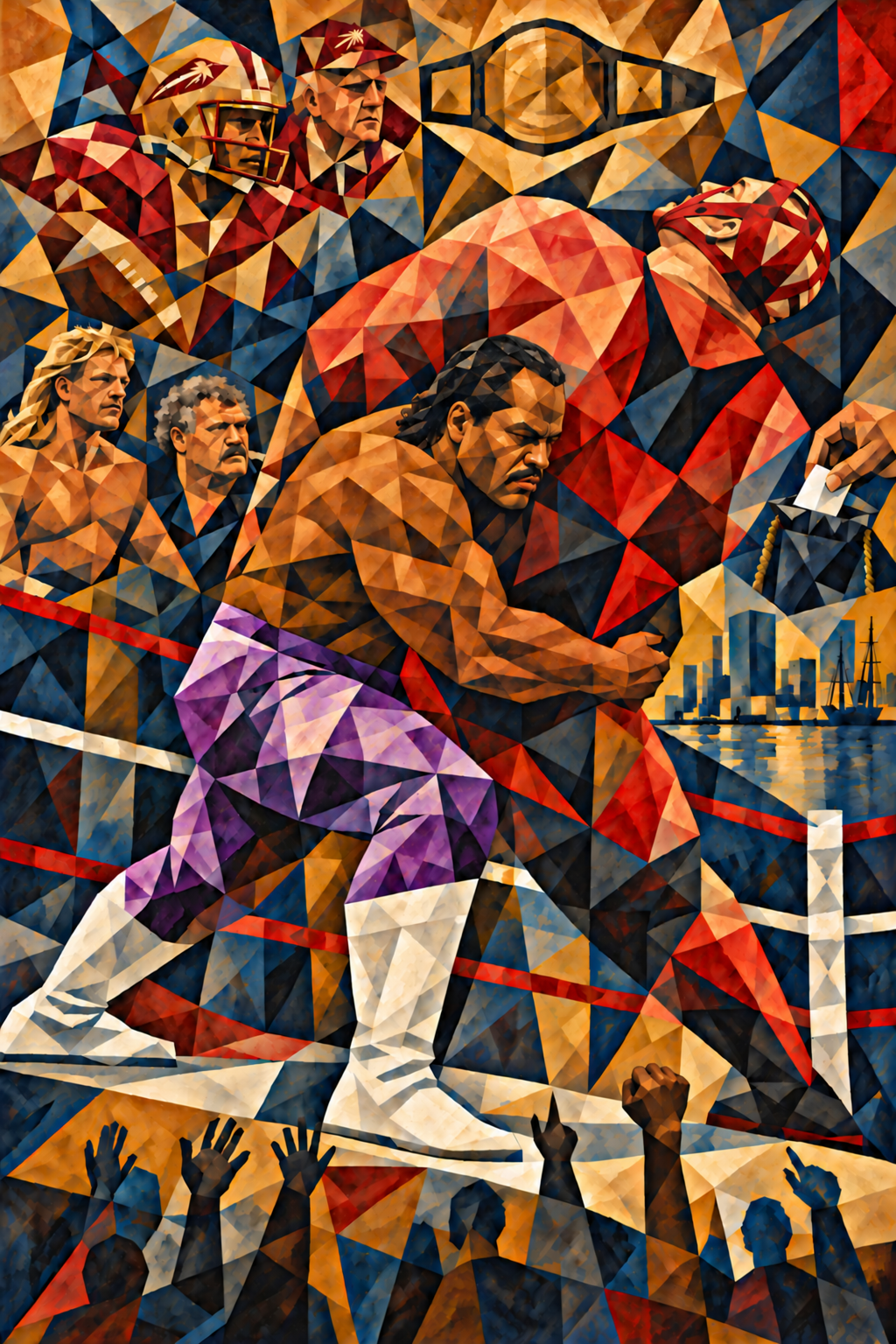
Original work for The InsideCount. A symbolic interpretation of Simmons' preparation, championship pursuit and breakthrough in Baltimore. "The Journey"
Every match in professional wrestling ends with a result. The Deciding Fall looks at how it was earned: the decisions, adjustments and moments under pressure that separate winning from losing. We begin with Ron Simmons, a sudden opportunity against Vader, and the earlier championship battles that help us understand his greatest moment.
Baltimore was supposed to be Sting's chance to put things right. Three weeks earlier, Big Van Vader had taken his world championship at the Great American Bash. On August 2, 1992, Sting was getting another shot at the man who had battered him and left with the belt.
Then Jake “The Snake” Roberts came through the crowd. After years in the World Wrestling Federation, one of wrestling's most calculating opponents was suddenly here in World Championship Wrestling and heading for Sting. Why Sting, and why now? Roberts attacked him with a steel chair. Sting had come to Baltimore prepared to fight for a championship; he was now being assaulted with a weapon before that contest could even begin. Roberts then drove his head into the chair with a DDT. Once was not enough. He did it again. Two head-first impacts onto steel, and Sting's chance to reclaim the title was gone. Before Vader had to defend against him, someone else had left the challenger unable to compete.
That left WCW executive Bill Watts with a champion ready to defend and a challenger who could no longer compete. He arranged a drawing among the contenders on hand. Out came the name of Ron Simmons, a former world tag team champion who knew what it felt like to get close to the singles title and leave without it. Watts offered him time to get ready. Ron wanted Vader now.¹
You may remember what happened next. But knowing the result is one thing; understanding how it happened means going back before the final three-count. Simmons was about to face the man who had battered Sting and taken his championship. What could Ron bring to this fight that would give it a different ending?
The First Shot at Gold At Halloween Havoc, WCW's October 1991 pay-per-view, Simmons had taken the fight to Lex Luger. Luger held the world championship. Ron, already a world tag team champion alongside Butch Reed in Doom, was trying to establish himself at the top of the singles division.
Simmons hardly looked out of his depth. He took the initiative in the early exchanges, bringing the fight to a champion whose own strength was usually an advantage. Ron could move Luger, put him under pressure and make him defend. The question was whether he could sustain it when the champion answered.
A missed dropkick gave Luger that chance. Simmons had committed to an attack and come down without connecting, leaving the champion an opening to take over. Ron now had to recover the initiative he had surrendered.
He did. A clothesline and a powerslam put Luger back under pressure, and Simmons followed with the spinebuster, driving the champion onto his back. This time, Luger could not get out of the cover.
Ron had the first fall. He had gained control, lost it and fought his way back to a pin over the world champion. Ordinarily, that would be the moment the ref handed him the belt.
This match required two falls. Luger still had a way back.
Between falls, Simmons could turn to a man who knew what it took to leave with the championship: Dusty Rhodes, the former world heavyweight champion known as the American Dream. Dusty had been announced as Ron's cornerman before the event, and his presence answered a problem on the other side of the ring. Luger had Harley Race. Simmons needed someone who could offer championship advice while keeping an eye on the champion's manager. Dusty had already warned Race not to cross him in the buildup. Now Ron had the opening fall, and the veteran in his corner was urging him toward the next one.²
Across the ring stood Harley Race. An eight-time NWA World Heavyweight Champion, Race had spent years defending the title against challengers that included Dusty himself. He understood the pressure Ron was trying to put on Luger because he had once made a career of surviving it. By 1991, he had moved into management, putting that experience behind another man's pursuit of the championship. Luger now had one of wrestling's most accomplished champions advising him from the floor.³
That made Dusty a valuable ally: he understood both championship pressure and the man across the ring. Even with him there, though, Race found a way to influence the result.
Simmons kept pressing in the second fall, making Luger answer one pin attempt after another. Ron was doing the attacking; the champion often looked as though getting a shoulder up was about all he could offer in return. Each escape left Simmons with more work to do. He had to get Luger back into trouble, put him down and try again.
Luger was struggling to take command, but he kept denying Ron the three-count that would end his reign. There is a difference between controlling a match and keeping yourself in it. For that stretch, the champion was managing the latter. Every kickout made Simmons earn another opportunity and kept open the possibility that Luger might find one of his own. But when the champion sidestepped a running attack and Ron went to the floor, the pursuit cost him his momentum. Luger took the offensive. Simmons could still find openings, but he was having to fight for control again. Then Race intervened.
Luger charged at Simmons against the ropes with a crossbody, throwing his body into the challenger. From the floor, Race grabbed Ron and held him inside the ring while Luger spilled over the top rope.
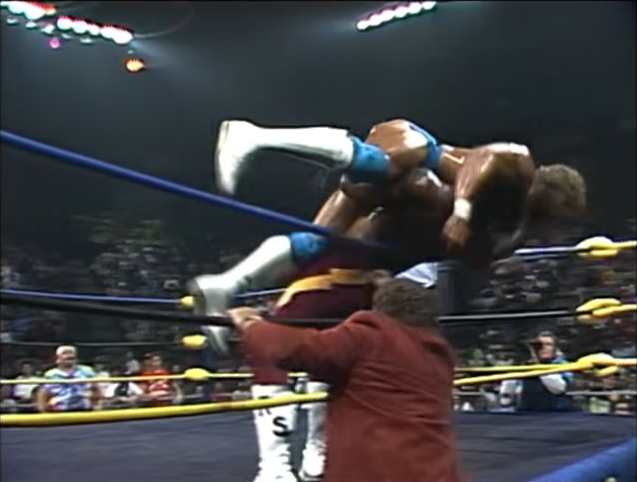
An extra pair of hands. Race holds Simmons at the ropes as Luger goes over. The champion would receive the second fall by disqualification, erasing Ron's lead without having to pin him. Dusty had come to counter Race's influence; here, that influence helped change the match. Watch the sequence from 2:38:10. Source: WCW footage, official WCW YouTube upload, Halloween Havoc, October 27, 1991.
Under WCW's rules at the time, throwing an opponent over the top rope to the floor was grounds for disqualification. The ruling treated Luger's exit as an illegal throw by Simmons, even though Race's grip had kept Ron inside as the champion went out. Luger was awarded the second fall. Ron's lead was gone without the champion having to pin him.
In the deciding fall, Simmons pursued Luger outside and charged at him against the ring post. Luger moved. Ron's shoulder struck the steel, and the challenger who had kept making the champion defend was suddenly vulnerable. Luger gave him no time to recover. Back inside, the champion delivered his Attitude Adjustment piledriver, adding impact to Ron's head and both shoulders, including the shoulder that had just struck the post. This time, Simmons could not escape the pin. Simmons had made him fight to keep that championship. Given one costly miss, Luger finished the job.⁴
It is tempting to remember the challenger doing so much of the attacking and say he deserved a better result. But Luger stayed in the contest long enough to take advantage when Simmons became vulnerable. That is part of defending a championship, too. Ron had proved he could win a fall against the champion. He still needed the one that settled the match. He had been close enough to pin the man wearing the belt, only to watch, in what anyone would call professional disappointment, as he left with it.
Before the Luger match, viewers had heard an endorsement from someone who knew what Ron could bring to a major contest. Bobby Bowden was the Florida State head coach who had helped build the Seminoles into a national football power, with Simmons anchoring his defensive line and earning consensus All-America honors in 1979 and 1980.⁵ In a recorded message shown before the championship bout, Bowden told Ron he had done everything he could to prepare for it.⁶ Bowden knew the competitor behind that preparation, and Ron's performance against Luger gave substance to his confidence. Simmons lost, but he had arrived ready to challenge the champion and pushed him to a deciding fall. Preparation could not promise him the belt. It could put him in a position to win it when the chance came. In Baltimore, that chance would unexpectedly come again.
Months later, Simmons publicly declared what he wanted: to win the World Heavyweight Championship and become WCW's first Black world heavyweight champion. When Harley Race confronted him alongside the masked Super Invader, another wrestler in his charge, Ron stood his ground. This was the same manager whose interference had helped undo his lead against Luger. Simmons still wanted the world title, and Race's presence was not going to stop him saying so.⁷
What Sting's Defeat Told Us
By the summer of 1992, Sting was the champion WCW's fans had rallied behind: face paint, explosive athleticism and the strength to stand his ground against the biggest names in the division. He had beaten Ric Flair for a world title in 1990. That February, he had taken the WCW championship from Luger at SuperBrawl II. His place at the top had been earned against men who knew how to defend it.⁸
Big Van Vader had built his reputation in Japan before making WCW his next championship pursuit. In New Japan Pro-Wrestling, he had defeated Antonio Inoki, one of the country's most celebrated wrestlers, and become the first foreign wrestler to win its IWGP Heavyweight Championship. By the summer of 1992, he had held that title three times. WCW had first seen him at the 1990 Great American Bash, where he overwhelmed Tom Zenk in little more than two minutes. The massive masked challenger arriving for Sting's belt brought an international championship record to match his intimidating presence.⁹
His offense explained that reputation. Vader could hammer an opponent with short, heavy punches, then bring his full weight down on him with a splash. Sting was accustomed to being powerful enough to change a match with one burst of offense. Against Vader, even creating room to use that offense would be a fight.
And there was Harley Race again. Sting had taken the championship from one of his men; now another was coming for it. Race brought the same championship experience and willingness to interfere that Simmons had encountered against Luger. The man inside the ropes had changed. The danger at ringside was familiar.
On July 12, at the Great American Bash in Albany, Georgia, Sting put his title on the line against Vader. Within the opening exchanges, Vader's heavy strikes had sent him outside for breathing room. The man carrying the belt was being made to react to the challenger.
Then Sting answered. An enormous back body drop helped send Vader into retreat. Sting could lift him, throw him and force him outside. For a few moments, the champion's strength seemed capable of changing the terms of the fight.
Sting needed time after those big efforts. Getting Vader off his feet demanded work; following up demanded more. Vader could answer with a heavy blow and leave Sting rebuilding the momentum he had just fought so hard to gain.
Hurting Vader gave Sting very little time to enjoy the accomplishment.
Vader also made Sting work just to get back to his feet. He trapped him in a step-over toe hold, keeping pressure on the leg while the champion struggled to free himself. For roughly two minutes, Sting's explosive offense was out of reach. His immediate task was escaping the hold.
When he finally got loose, he rose unsteadily. Those were the legs he needed to launch the Stinger Splash and to support Vader's weight when he tried to lift him. Escaping had ended the hold; it had not given Sting an opportunity to recover before the next exchange.
Later, with Vader perched on the turnbuckle, Sting got underneath him and lifted the big man across his shoulders in a fireman's carry. The strain was unmistakable. His whole body appeared braced against Vader's nearly 450 pounds, fighting to keep the challenger supported as he carried him away from the corner. On legs that had already endured Vader's toe hold, Sting was now holding up the challenger himself.
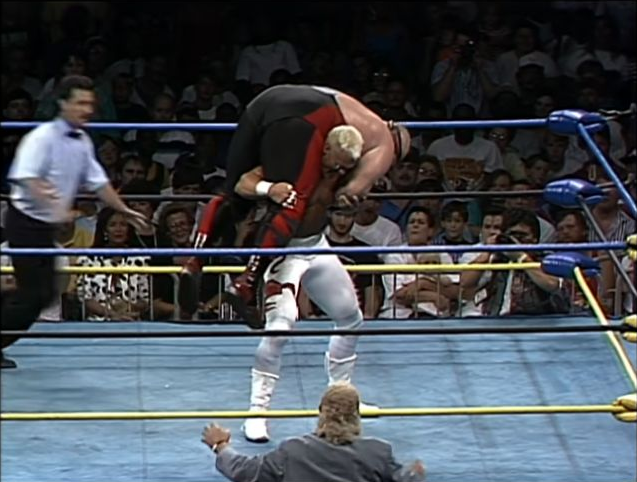
Strength at a price. Sting supports Vader's billed 448 pounds across his shoulders before completing the slam. The achievement is remarkable; so is the effort demanded of a champion whose legs had already been worked over. Moving Vader was only part of the problem. Having enough left to follow up was another. Watch the sequence at 2:10:51. Source: WCW footage, official WCW YouTube upload, The Great American Bash, July 12, 1992.
Then he dumped Vader onto the canvas. It was an extraordinary feat of strength, but look at what it demanded of the champion: lifting that weight, holding it steady and carrying it before he could complete the attack. Sting needed time to recover instead of going straight into a follow-up. He had put Vader down, but the effort had taken something out of him, too.
When Sting launched a Stinger Splash, his running leap into an opponent in the corner, his head struck the turnbuckle. He came away bloody and unsteady. Vader seized the opening, lifted him for the powerbomb and drove him back-first into the canvas to win the championship.¹⁰
Had the leg work and those exhausting lifts taken something out of Sting's final leap? The question is worth asking. What we can see is that Sting had fought hard enough to move Vader and hurt him, yet Vader remained dangerous enough to end the match when the opening came.
Twenty-one days later, Simmons would have to find a way through that same pressure.
Make The Champion Defend
Back in Baltimore, Jake Roberts' attack had left Sting unable to take his rematch. Vader still had a championship to defend, so Bill Watts gathered the contenders and put their names into a bag to choose a replacement. The name drawn was Ron Simmons. Months of pursuing another title shot had come down to an unexpected invitation, and Ron accepted immediately. Across the ring waited Vader, with a familiar figure in his corner: Harley Race.
Baltimore began more cautiously. Vader did not immediately march Simmons backward as he had Sting. Ron stood before him, inviting the engagement, and the opening lockup gave neither man an easy advantage.
Vader landed a right hand that stopped Simmons momentarily. Ron answered with punches of his own. Soon the challenger was driving the exchanges, and a shoulder block sent the champion rolling outside.
Simmons was making the champion retreat. Anyone who had watched him against Luger had reason to believe he possessed that kind of power, but demonstrating it against this champion was another matter.
The retreat gave Vader a break in the action. Simmons pressed again when he returned and threatened a pin. Ron was making the most of an opportunity that had not even been his when the evening began.
Then Vader found the counter he needed. A knee stopped Simmons' advance, and the champion went to work with his punishing corner strikes. The room Ron had created for himself began to disappear.
This is where the match becomes more revealing than the early surge. Plenty of challengers can look convincing while their offense is working. What happens when the champion takes that away?
Stay In It. Find The Next Opening.
Vader brought his enormous weight down across Simmons with a splash from the middle rope. Ron escaped the pin, but getting a shoulder off the canvas did not put him back in charge. He still had to face the next attack.
Against Luger, Ron had been the man forced to attack again every time a shoulder came up. Now he was the one beneath the champion, finding enough to prevent the three-count without yet having an answer to the offense. He knew how frustrating those escapes could be for the man on top. Here, they were keeping his own title chance alive. Vader still had to finish him.
Then Vader tried to lift him for a suplex. Simmons blocked it.
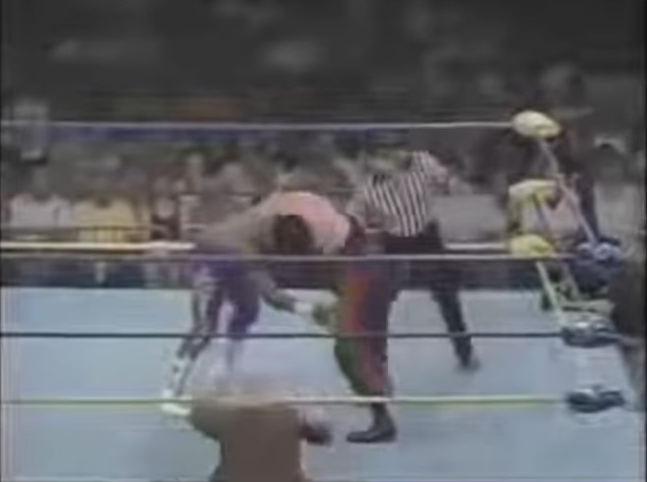
The defensive stop. Ron has spent this stretch absorbing Vader's offense. Here, he denies the champion another hard landing. We see this blocked suplex as the turning point: Simmons keeps himself in the contest, then turns resistance into an attack of his own. For a former defensive lineman, it is a familiar principle. First, stop the advance. Watch the block and counter from 8:02. Source: WCW footage, uploaded by Pro Wrestling's History Brigade; Baltimore, August 2, 1992.
This seemed to be the turning point of the match. Until then, Ron had been surviving the damage Vader delivered. Here, he stopped the next impact from happening. After the strikes and the splash, he still had enough resistance to deny the champion the lift.
It did not put Simmons in control. Vader remained dangerous, and Ron still had to find his way back into the fight. But the champion had been making him absorb one punishing attack after another. This time, Ron held his ground. The shift began with a defensive stop.
For a former Florida State defensive lineman, the shape of the problem was familiar: an opponent was advancing, and he needed a stop. Holding his ground would not put points on the board. It would keep the next opportunity within reach.
Simmons turned the blocked lift into a suplex of his own, taking Vader over and bringing him down. Now the champion had absorbed a hard landing.
But Vader got up first. Another blow put Ron under pressure again. Simmons found a backslide, pulling the champion's shoulders toward the canvas. Two Count. Vader escaped and came back at him.
Then Vader charged into the corner and missed. Ron seized another chance at a pin. Again, the champion kicked out. Simmons was making him defend, but he could not keep him there.
Ron tried a sunset flip, attempting to pull Vader backward into another cover. Vader stayed upright, then dropped his weight onto Simmons' chest. The challenger was underneath him again.
Every opening Ron found was becoming a struggle to survive the answer. Now Vader had him down and went to lift him once more.
One Opening, One Fall
Vader went for the powerbomb.
We had seen where that could lead. Sting had left the Great American Bash without his championship after Vader delivered it. Now the champion was trying to put Simmons through the same ending.
Ron slipped free and landed behind him.
Vader hit the ropes and came back at him. Simmons caught the big man, drove him to the canvas with the powerslam and covered him.¹¹
One. Two. Three.
The crowd rose. Jim Ross, who called the match, would remember the reaction years later as celebration mixed with disbelief.¹² The man selected to fill an empty place on the card had just become world champion.
Wrestlers came out to congratulate Simmons. Then Dusty Rhodes embraced him. At Halloween Havoc, Dusty had encouraged Ron through a challenge that ended with someone else holding the belt. This time, there was no second fall to chase and no lead to protect. The match was over. Ron had won.
Look back at those earlier title fights, and Ron's victory takes on another dimension. Against Luger, he had learned how little an attacking advantage guaranteed when the champion kept escaping his covers. Against Vader, Ron needed that same stubborn defense. Every kickout kept him close enough to find another opening.
Sting had shown that even a champion strong enough to lift the Mastodon could spend himself doing it. Going toe to toe with Vader carried a punishing cost. Ron traded blows too, but his decisive work came in denying Vader: blocking the suplex, escaping the powerbomb, then catching him on the return. He did not need to win another prolonged exchange of strength. He needed to make that opening count.
Had Simmons carried lessons from Luger into Baltimore? His performance makes a persuasive case. The contrast with Sting's defeat helps explain what worked here. Ron survived losing control and still had an answer when Vader tried to finish him.
That brings us back to Bobby Bowden. Before the Luger challenge, the celebrated Florida State coach had told his former player that he had done the work to prepare. That preparation had not guaranteed victory then. In Baltimore, the opportunity arrived without notice, but it reached a man who had already challenged for the title, endured disappointment and kept pursuing it. Ron could not have known his name would come out of that bag. He was ready when it did.
WCW had its first Black World Heavyweight Champion. Amid the celebration stood the athlete Bowden had encouraged and Dusty had supported through an earlier disappointment. The title he had been pursuing was finally his.
Sometimes the moment that changes a career arrives by chance. What a man brings to it has been taking shape for years: in the work, the defeats and the decision to keep going. The drawing got Ron Simmons into the match. He earned everything that followed.
Sources & Match Footage
1. Baltimore, August 2, 1992: WCW 1992 event chronology and television chronology, covering Roberts' attack, the replacement drawing and Simmons' title victory. Dates of matches and television airings may differ.
2. Dusty Rhodes in Simmons' corner: 1991 television buildup, including Rhodes' warning to Race and the announcement of his ringside role.
3. Harley Race's championship and managerial career: WWE biography and Harley Race's official website.
4. Lex Luger vs. Ron Simmons, Halloween Havoc, October 27, 1991: Official full-event YouTube upload. Previously located finish clip (36 seconds, not the full match). Results and falls, sequence review and Attitude Adjustment identification. Analysis also draws on our viewing notes.
5. Simmons at Florida State: Florida State University Hall of Fame biographies, documenting his career under Bowden and consensus All-America honors.
6. Bobby Bowden's preparation message: Official WCW Halloween Havoc 1991 upload, preparation feature at 2:16:31. Bowden's preparation statement begins at 2:17:37. Located in the upload's timestamped transcript; paraphrased in the article. Event date: October 27, 1991.
7. Simmons' championship ambition and confrontation with Race and Super Invader: Confrontation clip on YouTube, uploaded by Scott's Wrestling Collection. Clash of the Champions XIX event account identifies the interview about becoming the first Black world champion and the confrontation. Recorded June 16, 1992; aired June 22. The short upload has no verified segment timestamps.
8. Sting's championship background: WWE biography and SuperBrawl 1992 material.
9. Vader's career before the title match: WWE on his Inoki victory and IWGP championship milestone and career retrospective covering his three IWGP reigns and WCW debut.
10. Sting vs. Big Van Vader, Great American Bash, July 12, 1992: Official full-event YouTube upload. Official full-match video. Analysis draws on our viewing notes. A match account gives Vader's weight as 448 pounds, described here as nearly 450.
11. Big Van Vader vs. Ron Simmons, Baltimore, August 2, 1992: Full-match YouTube upload used for the screenshot (Pro Wrestling's History Brigade, third-party upload; blocked-suplex sequence at 8:02). YouTube retrospective supplied in the original research (supplementary, not a full-match source). Official video archive page, detailed match account and closing-sequence corroboration. Analysis also draws on our viewing notes. Archive and broadcast date labels may differ from the match date.
12. Jim Ross on the crowd's reaction: WWE retrospective on the twentieth anniversary of Simmons' championship victory. Ross' recollection is paraphrased.
---
■
From the crowd
Join the conversationWhat's your take? Keep it about the wrestling. Respect the person on the other side of the ropes.
Sign in with your free membership to join the discussion. Comments are reviewed before appearing.